
“Textiles aren’t just decorative. They carry stories, memory and labour.”
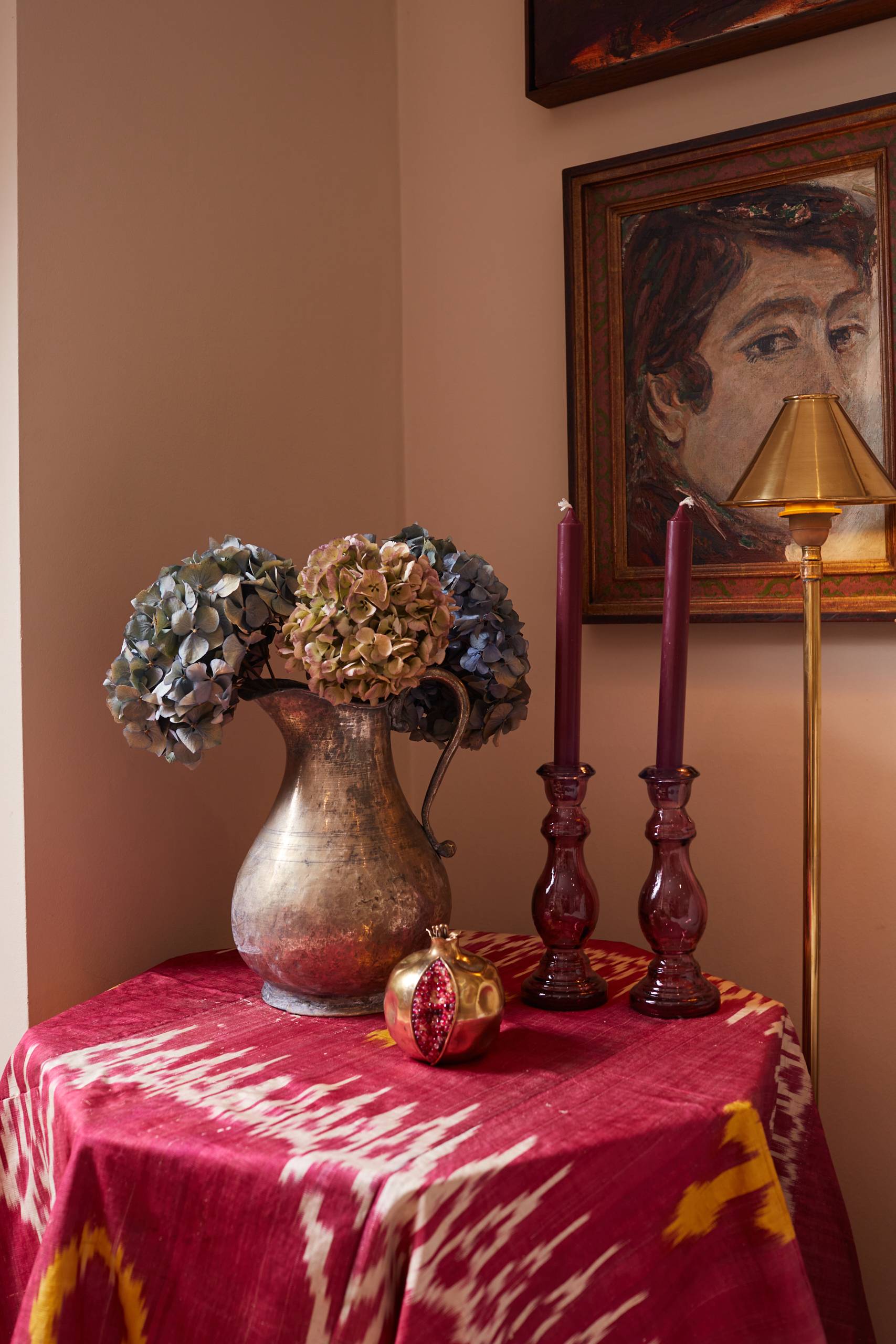
On a rainy London afternoon, the light outside is muted, but Zeynep Ugan’s living room feels warm and intimate. The light drifts across ikat-patterned curtains, settling on a hand-embroidered Suzani draped over the sofa. Behind it, mid-century Turkish portraits watch quietly from the walls. Moroccan ceramics and ancient Ottoman copper serving dishes rest nearby—folded into daily life rather than arranged for effect.
The room reveals itself gradually. It is not a space built around a specific look, but around objects that arrived with intention. This approach—personal, layered, quietly expressive—feels increasingly relevant: design is moving away from universal solutions toward spaces that feel authored, shaped by memory rather than market logic.
This shift points to something larger. In a world increasingly mediated by screens, there is a renewed desire to reconnect—with nature, with our roots, and with one another. Interiors have become one of the most immediate ways to express that need. Natural materials, organic forms, and handmade objects resist speed and disposability. They ask us to slow down, to notice, to care.


For Ugan, founder of Desert Rose—a curated platform for art, design, vintage textiles, and artisanal objects inspired by the cultural heritage of the Middle East and North Africa—this sensibility is second nature. Growing up in Istanbul, surrounded by Ottoman architecture and interiors filled with antique carpets, Iznik ceramics, and hand-embroidered textiles, she learned instinctively that the old and the new were not opposites, but collaborators. “A sense of curiosity always leads you somewhere exciting,” she says—a thread that has run through her life and work.
That impulse deepened in London, where she trained as an art historian and spent over a decade working across museums and galleries. At the Victoria and Albert Museum, she worked closely with Middle Eastern and Islamic art collections, supporting initiatives such as the Jameel Prize, which foregrounds contemporary practices engaging with tradition. What struck her was not replication, but translation: calligraphy reimagined as abstraction, textiles treated as narrative objects, inherited techniques reworked within contemporary practice. This was not appropriation, but continuity—a dialogue between past and present, maker and material. Travel across Morocco, Lebanon, and the UAE only reinforced the idea that heritage and modernity could share space without hierarchy.
This dual exposure—to institutional knowledge and lived experience—shaped a sensibility that would later define Desert Rose and her work as an art curator and interior consultant. “I never started with a master plan,” Zeynep says. “I started by collecting things I wanted to live with.”
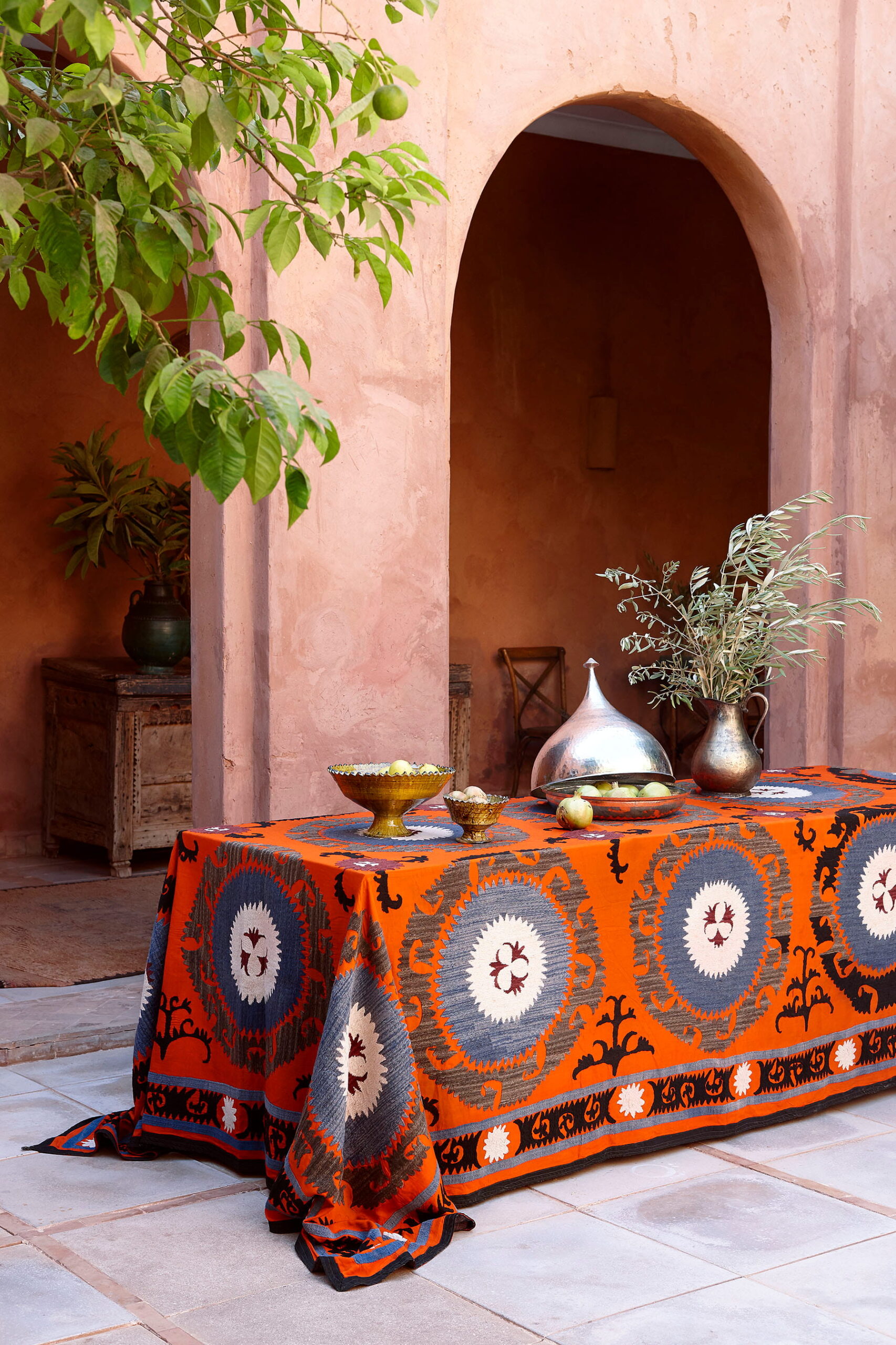
One of the most recurrent elements in her work and home is vintage textile. Suzanis—embroidered textiles traditionally made by women—are sourced from antique dealers in Istanbul and frequently appear as table throws, bedcovers, or even wall hangings. Once viewed as utilitarian, textiles are now increasingly recognized as carriers of history and identity. “They aren’t just decorative,” she says. “They carry stories, memory, and labour.” For her, they feel less like décor and more like diaries—stitched records of time and care.
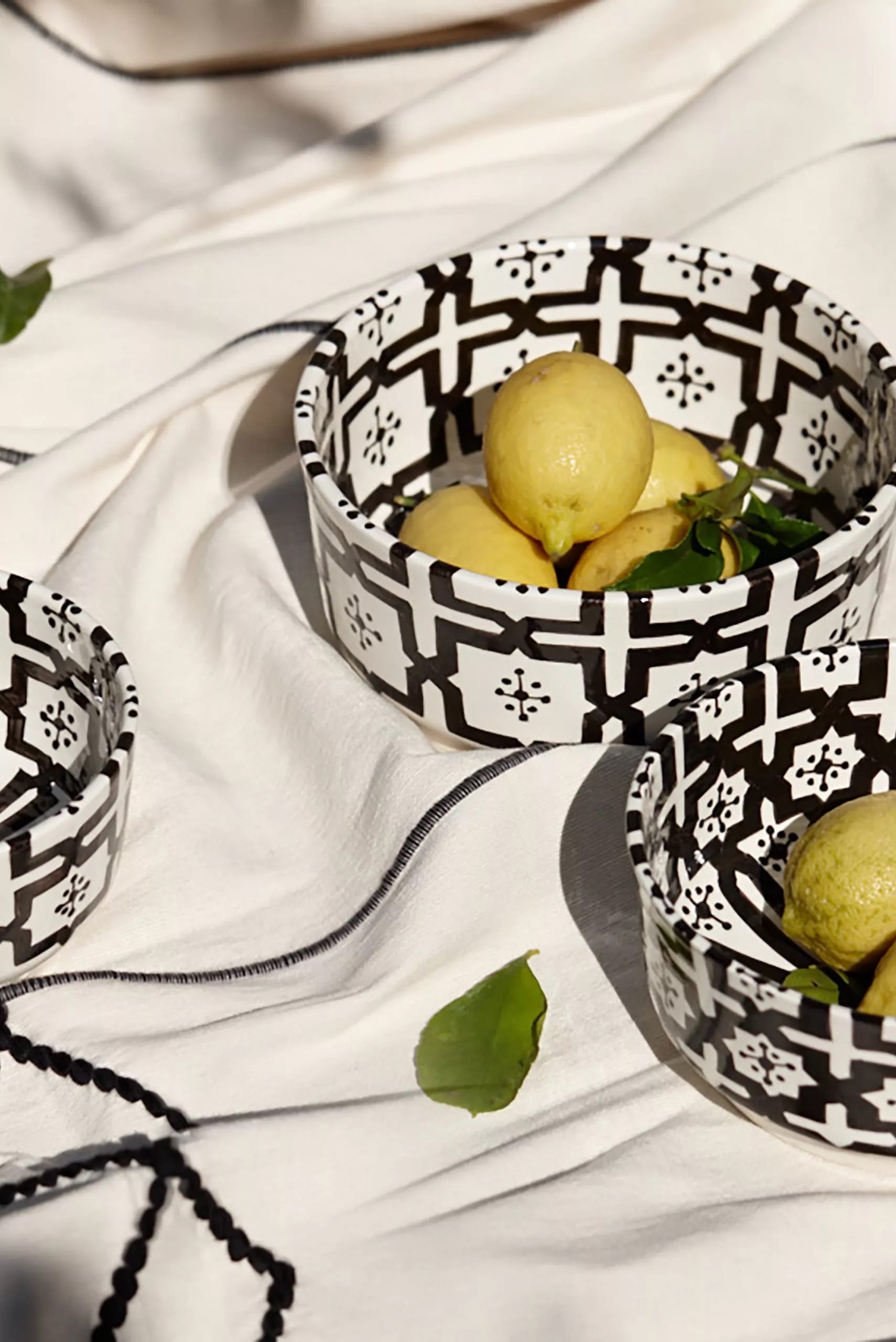
The same logic extends to the handcrafted ceramics that surface throughout her home, used as much as they are admired. Ugan recalls first encountering Fez ceramics at El Fenn in Marrakech, drawn to their irregular glazing and tactile surfaces. She also seeks out contemporary makers, such as Bouchra Boudoua, whose bright, hand-painted bowls hold fruit on her marble kitchen counter. “It adds vibrancy,” she says, “especially in moments of togetherness.” The object does not simply decorate; it sets a mood.
This is where mass production often falls short— patterned, yes, but anonymous. Perfectly repeatable, yet emotionally flat. Visitors instinctively notice the difference between mass-produced and authored.
That emphasis on authorship extends to art. In her living room, the scheme began not with furniture, but with a group of 1960s Turkish modern portraits inherited from her great-uncle. Intimate and deeply personal, they set the emotional tone of the space. “I wanted them to create a sense of closeness,” she explains—a reminder that art, when treated as a starting point, shapes how a room is experienced.
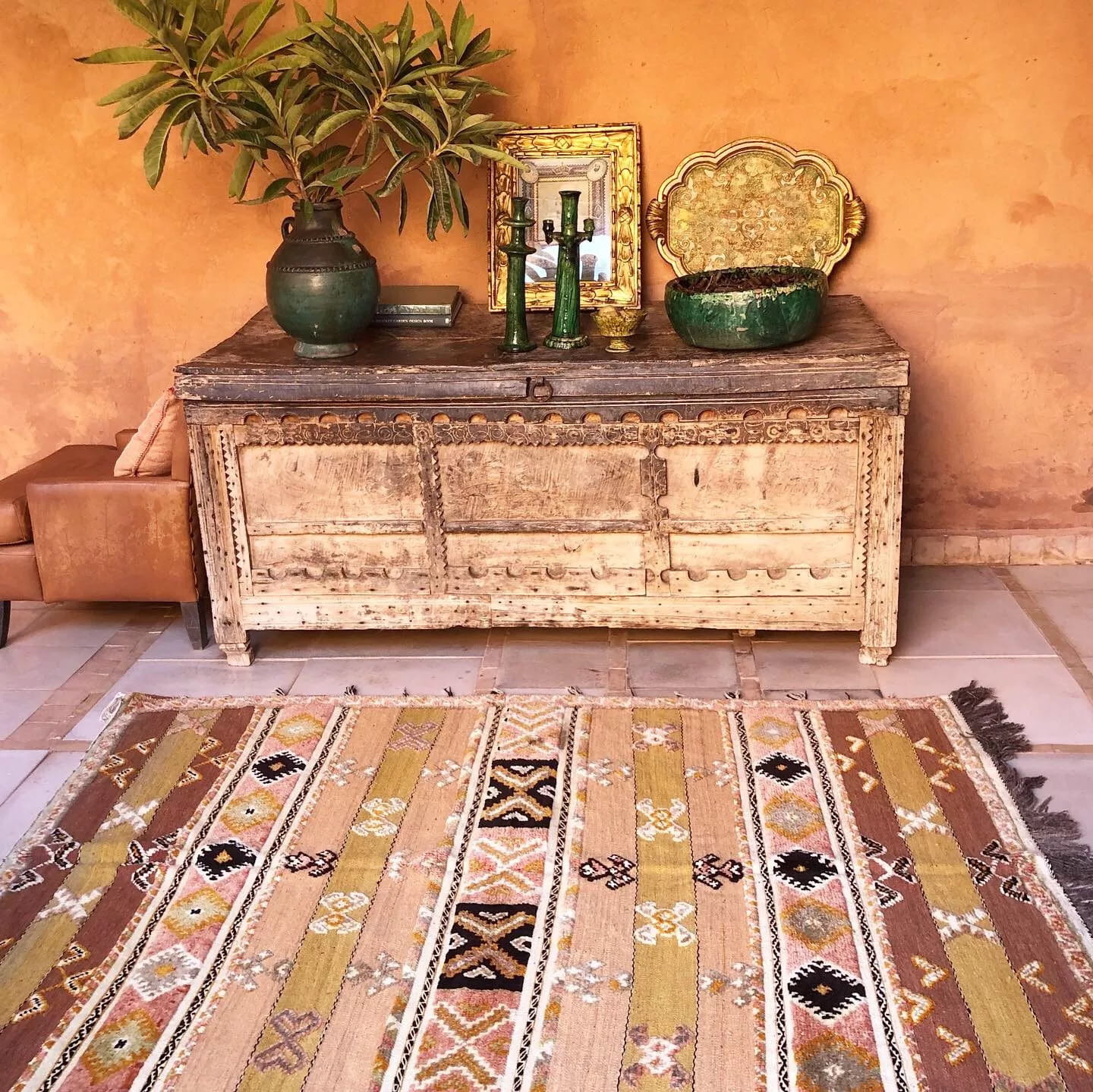


Today, her clients—collectors, creatives, and culturally curious homeowners—are less interested in perfect rooms than meaningful ones. Many live globally, move frequently, or feel disconnected from singular narratives of home. What they seek is recognition: objects that carry memory, labour, and story. A rug becomes a meeting point; a ceramic bowl carries a journey.
Yet many people still approach interiors with anxiety. Faced with endless choice, they default to what feels safe—neutral palettes, familiar silhouettes, mass-produced cohesion. “One of the biggest limitations people have is fear,” Zeynep says. “Especially fear of colour. White feels safe, but safety isn’t always where personality lives.”
In her own home, that fear is addressed through nuance rather than avoidance. Earthy beige walls soften the backdrop for her art, allowing colour to breathe without overwhelming the space. Personalization, she believes, is not about bold gestures, but thoughtful calibration.
Her advice is simple: start small. Choose one object that carries meaning—an inherited artwork, a textile from a journey, a ceramic used every day—and let the space grow from there. “If you start with one object you really love,” she says, “the rest of the space finds its way.”
A home, then, is not a finished image but a composition in progress. It is shaped by what we keep, what we inherit, what we return to. Personalization is less about style than about authorship—a move away from unconscious consumption toward spaces that are lived, layered, and unmistakably human. It is not a passing trend, but a cultural recalibration: homes defined not by how closely they follow a look, but by how honestly they reflect your life.

Stay Curious

Nine Beauty Brands Honouring Their Founder’s Heritage
Inspiration can often be found close to home, and that’s certainly the case for the latest must-tr

The Members’ Club is Dead. Long Live The Members’ Club
It was a mark of distinction when I first got my Soho House membership. I was in Patmos, Greece so t

Comedian Alia Rasul and Director Sura Mallouh Bring History, Heart and Humour With New Doc
Filipina-Canadian comedian Alia Rasul says she fell into filmmaking “by accident” during the pan

